
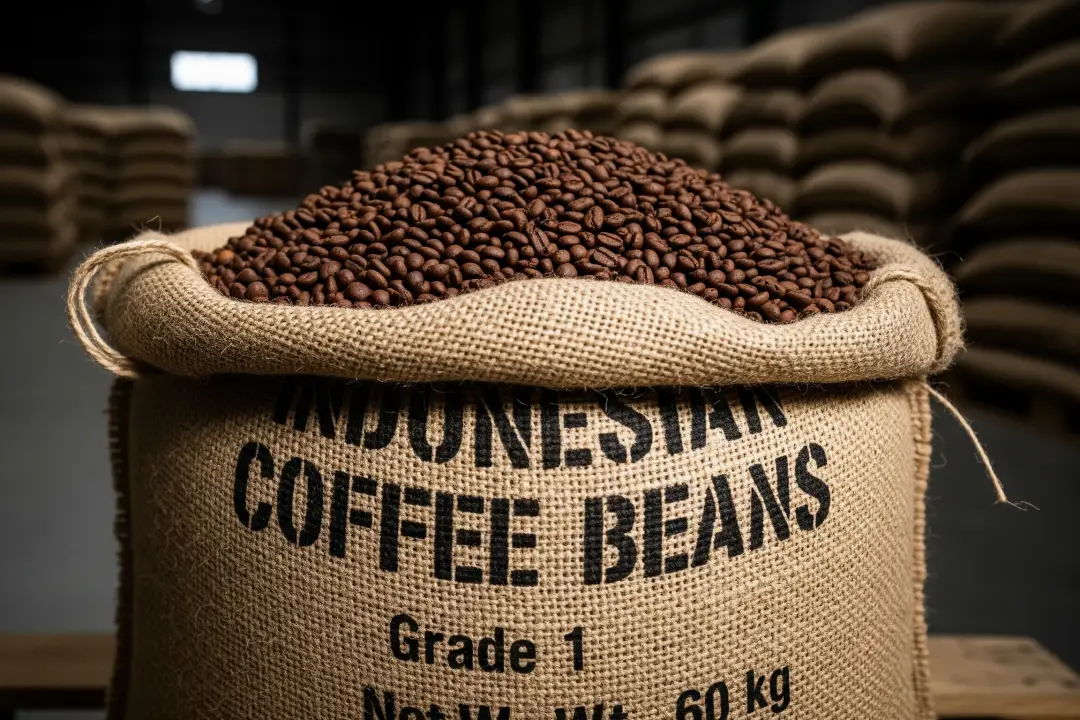
Importing coffee from Indonesia is one of the most rewarding sourcing decisions a roaster, distributor, or coffee brand can make. Indonesia is the world’s third-largest coffee producer overall and the largest producer of Robusta — offering a range of single-origin profiles unmatched by any other country. But navigating the process from first inquiry to container arrival at your port takes preparation.
This guide covers everything a B2B buyer needs to know: how to choose the right coffee and supplier, what documentation is required, how shipping and pricing work, and what to expect at each stage of the import process.
Step 1: Decide What Coffee You Want to Import
Before contacting any supplier, be clear on your requirements. Indonesian coffee falls into two main categories:
Robusta — Commercial & Specialty Grades
Indonesia produces approximately 85% of its coffee as Robusta, making it the dominant export product. The two most important origins are:
- Lampung Robusta (Sumatra) — Indonesia’s largest Robusta-producing province. Bold, full body, low acidity. Available in Grade 1 and EK-1. Year-round supply with consistent FOB pricing. Best for espresso blends, instant coffee manufacturing, and high-volume commercial roasting.
- Temanggung Fine Grade Robusta (Central Java) — Grown at 500–1,000 masl between Mount Sindoro and Mount Sumbing. Cleaner cup, lower astringency, superior crema. Best for premium espresso blends and specialty commercial roasting where cup quality matters.
Arabica — Specialty Single-Origin
Indonesia’s Arabica origins are among the most distinctive in the world, primarily due to the traditional Giling Basah (wet-hull) processing method unique to Indonesian coffee:
- Gayo Arabica (Aceh Sumatra) — Grown at 1,200–1,500 masl. Full body, earthy cedar notes, SCA cupping score 82–86. Indonesia’s most celebrated specialty Arabica origin. Organic and Fair Trade certified lots available.
- Bajawa Flores Arabica — Fully washed. Balanced milk chocolate, caramel, and bright floral notes. Popular with specialty roasters seeking origin diversity.
- Preanger West Java Arabica — Clean, bright cup with tropical fruit and brown sugar. Premier choice for specialty filter coffee.
Key Questions to Answer Before You Inquire
- Arabica or Robusta — or a blend of both?
- Green beans (for your own roasting) or roasted beans (for resale or private label)?
- What grade? (Grade 1, EK-1, Fine Robusta, Specialty)
- What certifications do you need? (Organic, Fair Trade, Halal, Rainforest Alliance)
- What volume? (Most suppliers require a minimum of 1 FCL — a Full Container Load — typically 17–19 metric tonnes of green beans)
- What shipping terms? (FOB, CNF, CIF)
Step 2: Find and Vet a Reliable Indonesian Coffee Supplier
The quality of your import experience depends almost entirely on your supplier. Here is what to look for:
Direct vs. Trading Company
Direct suppliers (like Swarna Agro) have their own processing facilities and direct relationships with cooperatives. They offer better pricing, full lot traceability, and more flexibility on grades and certifications.
Trading companies aggregate beans from multiple sources. Convenient but add cost and reduce traceability — not recommended if origin authenticity matters to your customers.
What to Check Before You Buy
- Export licence — Legitimate Indonesian coffee exporters hold an Eksportir Terdaftar (ET) registration from the Ministry of Trade.
- SGS or third-party lab certification — Ask for SGS test results on moisture content, screen size, and defect count for recent lots.
- ICO membership — Indonesia is an ICO (International Coffee Organization) member state. Your supplier should be able to issue an ICO Certificate of Origin.
- Export history — Ask for references or evidence of past container shipments. Swarna Agro, for example, has government-recognised exports certified by Indonesia’s Provincial Department of Industry and Trade (Disperindag).
- Certifications relevant to your market — Halal certification for Middle Eastern markets, Organic/Fair Trade for European and US specialty markets, Rainforest Alliance for ESG-conscious buyers.
Step 3: Request and Evaluate Samples
Never commit to a container without cupping the coffee first. Any reputable Indonesian supplier will send samples by air freight.
What to Request
- Green bean sample (200–500g) — Check appearance, screen size uniformity, moisture feel, and aroma.
- Roasted sample (100–200g, roasted to your preferred profile) — Cup against your standard evaluation protocol.
- Lab report — Ask for SGS moisture and defect analysis to accompany the sample.
What to Look For When Cupping
- Robusta: Clean, earthy aroma. No harsh rubber or ferment defects. Full body with thick, stable crema after roasting.
- Arabica (Giling Basah): Characteristic earthy sweetness, cedar notes, heavy body. Low-to-medium acidity. If you’re unfamiliar with the wet-hull process, expect a profile distinctly different from washed Central American or African Arabicas.
Typical sample turnaround from Indonesia to Europe or the US is 5–10 business days by air freight.
Step 4: Understand the Pricing Structure
Indonesian green coffee is typically priced on a FOB (Free on Board) basis — the seller delivers the goods to the named port of export (Belawan, Tanjung Priok, Semarang, or Makassar) and the buyer bears costs and risk from that point.
Approximate FOB Price Ranges (2026)
| Coffee Type | Grade | Approx. FOB Price |
|---|---|---|
| Lampung Robusta | Grade 1 / EK-1 | USD 2.50 – 4.50/kg |
| Temanggung Fine Robusta | Fine Grade | USD 3.00 – 5.00/kg |
| Gayo Arabica | Grade 1 Specialty | USD 5.00 – 9.00/kg |
| Gayo Arabica Organic | Grade 1 Organic Certified | USD 6.50 – 11.00/kg |
Prices are indicative FOB Indonesia and fluctuate with global commodity markets (NY/London futures) and seasonal harvest conditions. Always request a current quotation.
→ Visit our wholesale pricing page to see how quotes are structured, compare origins and grades, and submit a pricing inquiry — we respond within 24 business hours.
Additional Costs to Budget For
- Ocean freight (FOB to your port): USD 1,500–3,500 per FCL depending on destination and season.
- Import duties: Varies by country. Check your local HS code for green coffee (HS 0901.11 for non-roasted, non-decaffeinated). Many countries have preferential tariff rates for Indonesian origin under bilateral trade agreements.
- Customs clearance and forwarding: USD 200–600 depending on your agent and port.
- Port handling and warehouse delivery: Local charges at destination port.
Step 5: Know the Required Export Documents
A professional Indonesian exporter handles all export documentation on your behalf. Here is what should accompany every shipment:
Mandatory Documents
- Commercial Invoice — Itemised invoice with FOB value, grade, origin, weight, and HS code.
- Packing List — Number of bags, net/gross weight per bag, total weight.
- Bill of Lading (B/L) — Issued by the shipping line. This is your title to the goods — keep it secure.
- Certificate of Origin (COO) — Issued by Indonesia’s Ministry of Trade or Chamber of Commerce. Required by most importing countries for tariff determination.
- ICO Certificate of Origin — Required for shipments to ICO member countries (which includes most major coffee-importing nations).
- Phytosanitary Certificate — Issued by Indonesia’s Plant Quarantine Agency. Required by most countries for agricultural products.
Additional Documents (Depending on Requirements)
- SGS / Lab Inspection Certificate — Third-party quality verification of moisture, screen size, and defect count.
- Halal Certificate — Required for import into Gulf countries, Saudi Arabia, Malaysia, and others.
- Organic Certificate — Required if claiming organic status at the destination market.
- HACCP Certificate — Required by some food-grade importers and supermarket supply chains.
- Fumigation Certificate — May be required by some countries as a condition of phytosanitary clearance.
Step 6: Understand How Shipping Works
Container Types
Green coffee is typically shipped in a 20-foot FCL (Full Container Load). A standard 20ft container holds approximately 17–19 metric tonnes of green coffee in 60kg jute sacks (280–320 bags). 40-foot containers are used for higher volumes.
GrainPro liners inside jute sacks are strongly recommended for sea freight to prevent moisture absorption during transit. Insist on this with your supplier.
Main Indonesian Export Ports
- Belawan (Medan, North Sumatra) — Primary port for Sumatra origins: Gayo Arabica, Lampung Robusta shipped via transshipment.
- Tanjung Priok (Jakarta) — Indonesia’s largest port. Used for Java origins and as a consolidation hub.
- Semarang — Main port for Central Java origins including Temanggung Robusta.
- Makassar (Sulawesi) — Used for Sulawesi origins (Toraja, Flores).
Transit Times (Approximate)
- Indonesia → Europe: 20–30 days
- Indonesia → Middle East: 12–18 days
- Indonesia → USA (West Coast): 18–25 days
- Indonesia → Japan/South Korea: 7–12 days
- Indonesia → Australia: 10–15 days
Step 7: Place Your Order
Once samples are approved and pricing agreed, here is how a professional Indonesian coffee export typically proceeds:
- Pro-forma Invoice (PI) issued — Your supplier sends a formal quotation with all lot specifications, pricing, and payment terms.
- Deposit payment — Most Indonesian suppliers require a 30–50% deposit by T/T (Telegraphic Transfer) before production begins. The balance is paid before or against release of shipping documents.
- Lot preparation — Milling, sorting, grading, and packaging begins. Typically 10–14 days.
- Pre-shipment inspection — SGS or equivalent lab testing on the finalised lot. Results shared with buyer.
- Booking and loading — Supplier books the container and vessel. FCL loaded at the warehouse under supervision.
- Documents released — Supplier sends the full document set (B/L, COO, phytosanitary, SGS cert, etc.) upon receipt of final payment or as per agreed terms.
- Arrival and clearance — Your freight forwarder clears the shipment at destination. Green coffee is typically stored in a bonded warehouse pending customs release.
Common Mistakes First-Time Importers Make
- Skipping the sample evaluation — Never commit to a container without cupping. Indonesian Robusta and Giling Basah Arabica can surprise buyers unfamiliar with the profile.
- Not verifying certifications — Always request original certificates, not scanned copies. Verify directly with the certifying body when in doubt.
- Underestimating lead time — From order confirmation to FCL arrival at a European port can take 6–10 weeks. Plan your inventory accordingly.
- Ignoring moisture on arrival — Green coffee absorbs moisture during sea transit. Measure immediately on arrival and compare with the SGS certificate. Significant deviation should be flagged with your supplier.
- Working through too many intermediaries — Each intermediary adds cost and reduces traceability. Direct relationships with producers like Swarna Agro give you better pricing, faster communication, and full origin documentation.
Ready to Start Importing Indonesian Coffee?
Swarna Agro is a vertically-integrated Indonesian coffee supplier and exporter with direct relationships with cooperative networks in Lampung, Temanggung, and Gayo. We supply to importers, roasters, and distributors in 25+ countries and handle all export documentation, SGS testing, and logistics from our processing facility to your port.
- Explore our Lampung Robusta — Grade 1 & EK-1, year-round supply
- Explore our Temanggung Fine Grade Robusta — premium espresso blends
- Explore our Gayo Arabica — Grade 1 Specialty, organic lots available
- Review our wholesale pricing guide — understand pricing factors and request a current quote
- View our full coffee range
Contact our export team via WhatsApp →
